Development of Management Strategies
to Keep the North Sea healthy (DEMASK)

The Interreg DEMASK project is bringing together policymakers, scientists, NGOs and the maritime industry to advance management strategies and policy solutions that will address underwater noise pollution in the North Sea.
To compare the impact of different management scenarios and test policy options, identifying indicator species with a considerable vulnerability to underwater noise is a defined primary step. To support indicator species selection in the North Sea for underwater noise risk assessments, a trait-based framework for marine mammals, fish and invertebrates was developed within the DEMASK project.
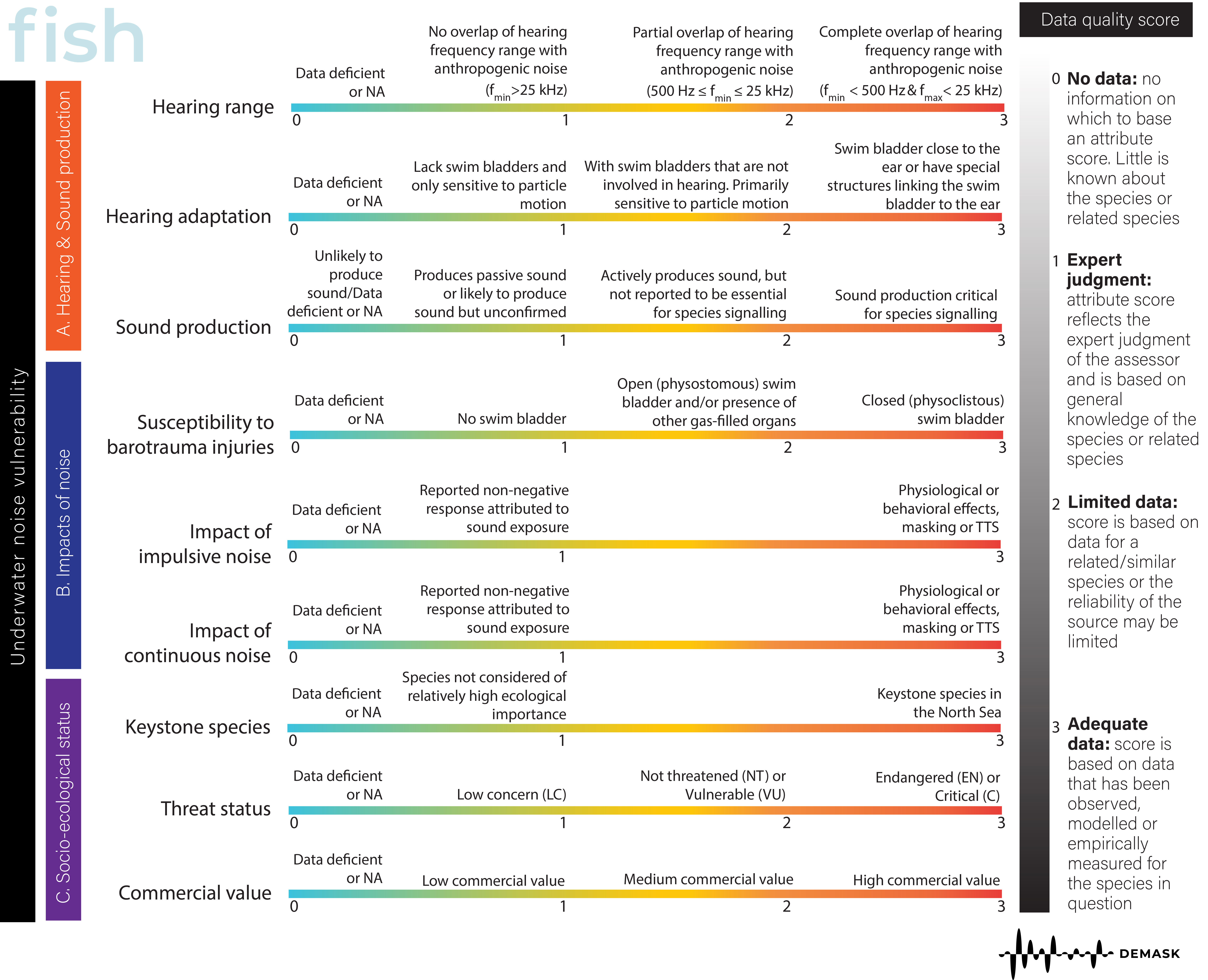
The trait-based framework (Figure 1) is a vulnerability scoring system based on different relevant attributes such as a species’ capacity to detect and produce sound, documented impacts from both impulsive and continuous anthropogenic noise, and the species’ socio-ecological significance. Each attribute is also given a data quality score based on the type, quality and reliability of the information used to evaluate each attribute.
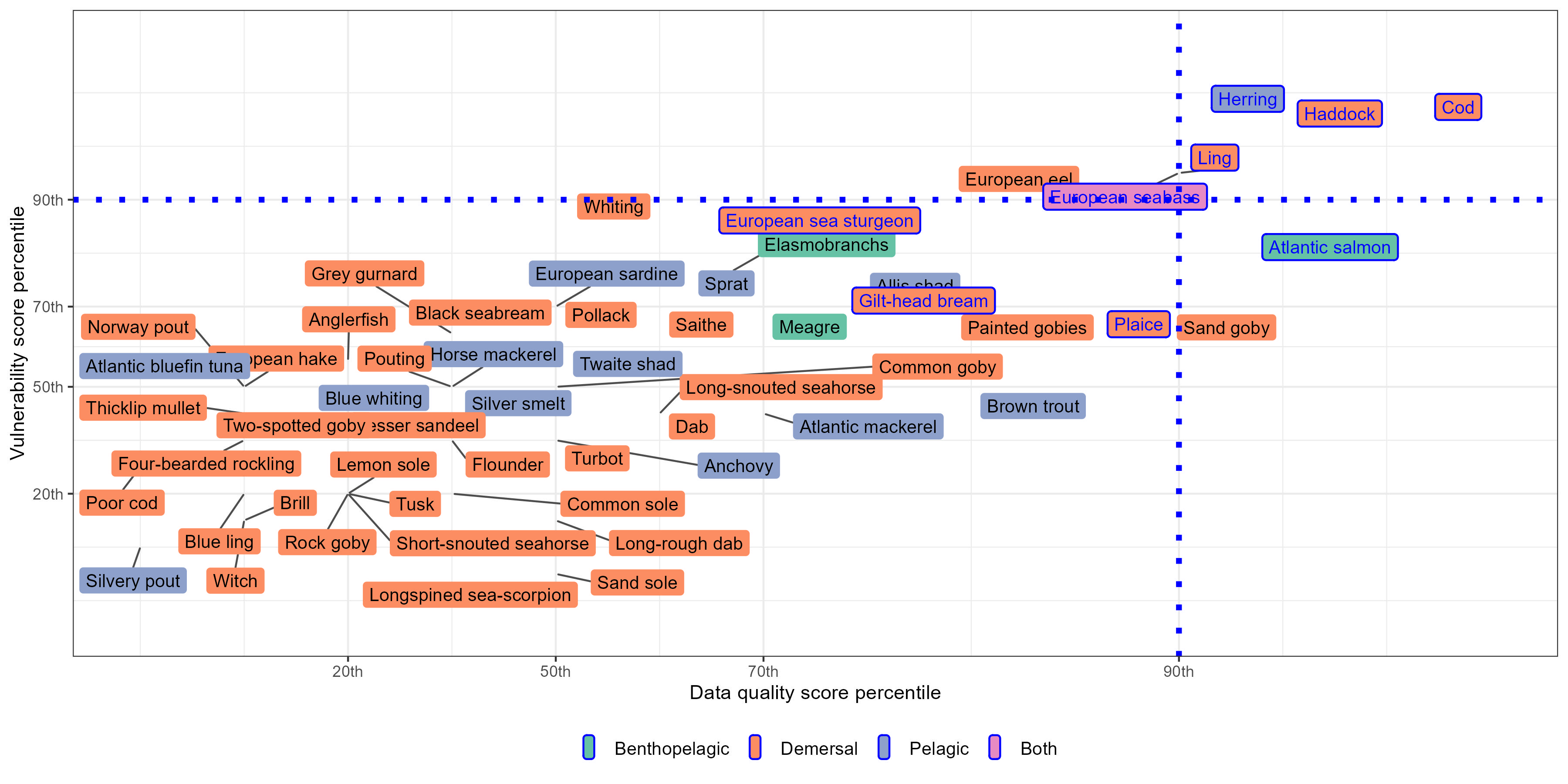
The result is an evaluation of 55 fish species (including elasmobranchs as a group) from the North Sea (Figure 2). Five potential fish indicator species were identified, falling within the upper 90th percentile of both vulnerability and data quality scores, which includes the Atlantic cod (Gadus morhua), haddock (Melanogrammus aeglefinus), Atlantic herring (Clupea harengus), ling (Molva molva) and European seabass (Dicentrarchus labrax).
Given that bioacoustics is a continuously evolving field, the vulnerability scoring framework is expected to highlight additional species of relevance as research advances. More significantly, the framework represents a step toward an ecosystem-based approach to underwater noise management, linking underwater noise to habitat loss among vulnerable species and the resulting impacts on their populations.
The full scoring table is available online.
Read the full publication in the Marine Pollution Bulletin.